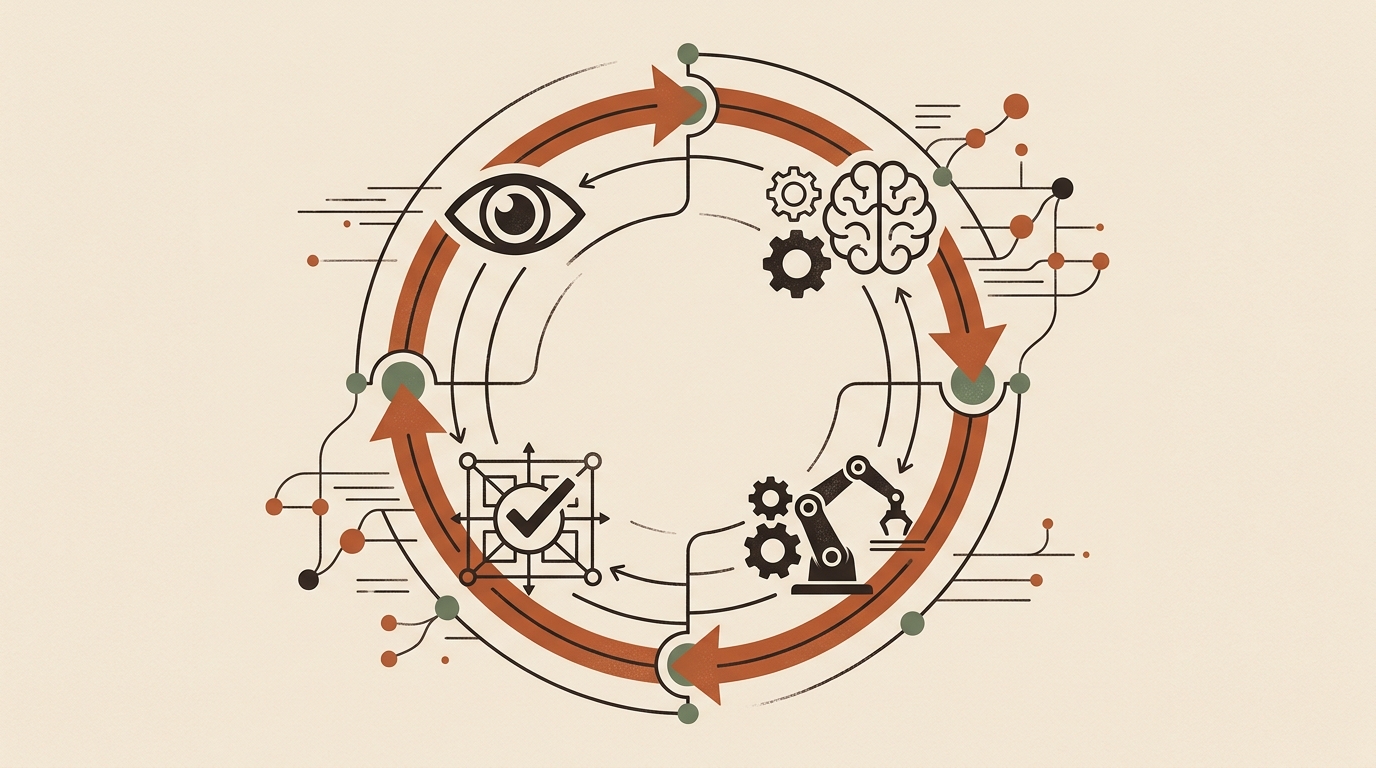
[!IMPORTANT] Visual Infographic Edition Available: We have built a modern, highly structured single-page visual infographic detailing the complete architecture and strata of Loop Engineering. Explore the Visual Infographic Presentation →
Most AI applications today are still stuck in the Linear Prompting paradigm. A user sends a prompt, the LLM processes it, returns a block of text, and the execution thread terminates. If the output has a syntax error, a failing test, or a logical hallucination, the run is considered a failure, requiring a human developer to manually inspect the error, adjust the prompt, and click run again.
Loop Engineering is the discipline of wrapping language models in self-healing execution loops. Instead of placing the human inside the loop as the primary feedback mechanism, we construct automated code and verification environments that observe the agent’s actions, evaluate exceptions, and guide the LLM to rewrite, run, and correct its code until a defined validation goal is achieved.
Prompting is planting a seed. Loop engineering is designing the climate that grows it.
1. Root Mechanics: Classical Code vs. Agentic Loops
To build reliable autonomous systems, we must transition from classical boolean state checking to probabilistic semantic evaluation:
- Environmental Triggers: Classical applications run on deterministic cron jobs or function calls. In an agentic loop, execution is triggered by event streams (such as automated webhooks, test failures, or git file-change events) that represent dynamic environmental shifts.
- The Execution Loop: Classical loops run static instructions. Agentic loops are model-directed; the LLM reads environmental feedback, reasons about exceptions, selects appropriate tools from its registry, and acts.
- Context Memory: Instead of static in-memory stack variables, agent state is accumulated in local text scratchpads, vector databases, and localized conventions (like AGENTS.md rulesets) that are dynamically read and updated between cycles.
- Validation Gates: Classical systems exit loops on boolean expressions (
while index < max). Agentic loops terminate when automated verifiers, unit test suites, or secondary model graders confirm the goal is met.
2. The 5 Core Building Blocks
A production-grade, self-sustaining loop requires five key engineering layers wrapped around the model core:
graph TD
    A[Environmental Triggers] -->|Webhook / File Event| B(Reasoning Core)
    C[Isolated Worktrees] <-->|Sandbox filesystem| B
    D[System Conventions] -->|SKILL.md / GEMINI.md| B
    E[Verification Layers] <-->|Test / Lint Graders| B
    F[Guardrail Boundaries] -->|Cost & Run Caps| B
1. Environmental Triggers
Loops do not run in isolation. They are spawned asynchronously by external changes—such as a webhook notifying the coordinator that a linting rule has failed, or a file-system hook trigger on codebase edits.
2. Isolated Worktrees
Autonomous execution must be sandboxed. Agents should operate within dedicated version control workspaces (like isolated git worktrees) so that experimental code changes or half-written logic doesn’t disrupt main development branches or overwrite production states.
3. System Conventions
To maintain codebase integrity, local conventions and architectural instructions must be dynamically loaded into the agent’s context. In our systems, this is managed via local config files like SKILL.md and GEMINI.md.
4. Verification Layers
The model must never decide on its own whether its work is complete. Secondary evaluation modules, compilers, linter suites, and automated test runners act as independent gatekeepers that approve output correctness.
5. Guardrail Boundaries
Safety checks are hard-coded outside the model’s control. These include token cost caps, maximum iteration limits (e.g., stopping the loop after 10 retries to prevent runaway API fees), and human-in-the-loop escalation paths for unexpected errors.
3. The Strata of Autonomy
We classify loop engineering into three distinct evolutionary tiers, mapping increasing complexity:
┌─────────────────────────────────────────────────────────────┐
│ LEVEL 3: Event-Driven Swarms (Async multi-agent orchestrations)│
│   ┌─────────────────────────────────────────────────────┐   │
│   │ LEVEL 2: Verification Loops (Self-correcting code)  │   │
│   │   ┌─────────────────────────────────────────────┐   │   │
│   │   │ LEVEL 1: Tool-Calling (Single-step APIs)    │   │   │
│   │   └─────────────────────────────────────────────┘   │   │
│   └─────────────────────────────────────────────────────┘   │
└─────────────────────────────────────────────────────────────┘- Level 1: Tool-Calling Loops: The base tier. The agent performs single-turn execution by calling external APIs, executing a script, or writing a file. Output verification is passed back to the user.
- Level 2: Verification Loops: The self-healing tier. The agent executes a tool, parses error feedback, writes a correction, runs tests, and loops iteratively until all validation gates pass.
- Level 3: Event-Driven Swarms: The coordination tier. Independent loops communicate asynchronously via pub/sub systems. An event in one workspace spawns subagents to resolve sub-tasks in parallel workspaces, coordinating state changes globally.
4. Systemic Health Metrics
Monitoring loop performance requires tracking systemic metrics to detect looping stagnation:
- Convergence Rate: The percentage of loops that terminate successfully by meeting the validation gates (target: >90%).
- Resource Cap: The maximum monetary budget allocated per task run (default: $5.00 limit).
- Iteration Limit: The maximum allowed retry loop cycles before executing human-in-the-loop fallback procedures (default: 10 cycles).
To explore this concept in a high-fidelity visual layout, visit our interactive presentation: AI Loop Engineering: Cultivating Autonomous Systems Infographic →